MVP development for startups: scope, timeline and fixed-price planning
Plan your startup MVP around one user journey. Learn what to include, how discovery shapes a development timeline and what a fixed-price proposal should cover.
THE SHORT ANSWER
Build the smallest complete journey that tests a business assumption, not a smaller copy of your entire future product. Agree acceptance criteria before agreeing a price.
Start with the assumption your MVP needs to test
MVP development for startups begins with a question, not a feature list. Will a particular customer use this workflow? Will they pay for the result? Can your team deliver the service reliably? A minimum viable product should help answer one of those questions with real behaviour. A polished demo that cannot complete the core task may impress someone without telling you whether the business works.
Write a short product brief before talking to an MVP development company: who the first user is, what problem they face, how they solve it today and what action would count as evidence of demand. Choose a measurable signal, such as completing a booking or returning to create a second report. Downloads and signups alone may not answer your business question.
You may not need custom software yet. Interviews, a clickable prototype or a manually delivered service can help test demand before a build. Use those approaches when the biggest uncertainty is whether people want the outcome. Build an MVP when users need a working product to test the assumption.
Scope one complete user journey
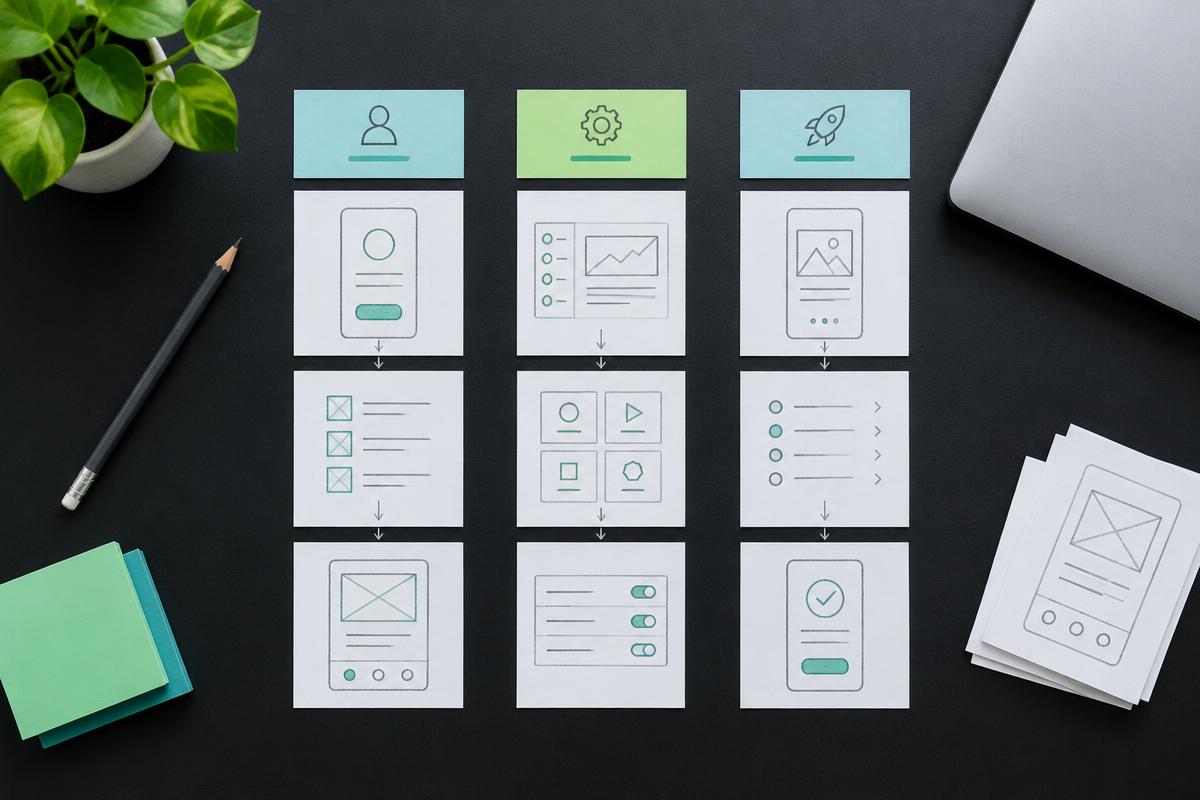
Imagine a booking marketplace. The initial journey might be finding an available provider, requesting a time and receiving confirmation. Recommendations, loyalty points and advanced analytics can wait. However, a way for your team to manage requests may be essential even if users never see it. Scope both the visible experience and the operations needed to deliver it.
For each feature, ask what breaks if it is absent. If customers can still reach the outcome and you can still measure the assumption, consider deferring it. Manual administration is a valid early trade-off, provided you understand who will do the work and how much time it takes.
- Identify one initial customer segment and its main task.
- Map the path from first visit to a useful result, including failure states.
- Separate launch requirements from later improvements in a written backlog.
- Define what must be protected: personal data, permissions and payment handling.
- Assign an owner to user feedback and decide what you will measure after launch.
How to plan an MVP development timeline
There is no universal MVP delivery time. Integrations, data migration, permission models and mobile store review can affect the critical path. A proposal should separate discovery, engineering, testing and external dependencies rather than hiding everything behind one launch date.
At SeedGeorgia, the published process starts with two weeks of paid discovery, followed by a build window of 2–12 weeks depending on scope. Our mobile service describes a focused first version as typically 6–12 weeks after discovery. These are our planning ranges, not industry benchmarks or a promise that any product fits them. The agreed timeline belongs in your project proposal.
Bring existing designs, access requirements and third-party documentation into discovery. Ask which decisions you must make and when. Delayed credentials, unavailable test data or unresolved requirements can block a team even when engineering is progressing well. Reserve time for acceptance testing and launch readiness, not only feature coding.
What a fixed-price MVP proposal should include
A fixed price is useful only when everyone understands what it buys. Compare proposals against the same scope rather than comparing a number at the bottom of different documents. One team may include deployment and handover while another excludes them. A lower headline price is not necessarily a lower total cost.
SeedGeorgia agrees a fixed proposal after discovery. Ask any development partner to explain how changes are handled: an additional feature should become an explicit scope decision, not an unspoken expectation. Hosting, payment processing, app store accounts and external services should be identified separately so you can plan ongoing operating costs.
- Deliverables and acceptance criteria for each core workflow.
- Included integrations, supported platforms and important exclusions.
- Milestones, demo schedule and founder responsibilities.
- Testing, deployment, documentation and code ownership.
- A written change process and the boundary between support and new features.
Launch with a learning plan and a handover plan
Decide how you will recruit the first users and collect feedback before the product is finished. Observe whether they complete the intended task, where they stop and what still requires your intervention. Fix barriers to the core journey before expanding into several new customer segments or adding features requested by only one user.
Handover should include source code, infrastructure access, deployment instructions and a clear list of known limitations. SeedGeorgia's published process includes full IP transfer and eight weeks of post-launch support. Confirm the exact support scope in your agreement. Your next milestone is not automatically a larger product: it is stronger evidence about what customers need.
Common questions
How much does MVP development cost?
There is no reliable price without scope. List the core workflow, platforms, integrations and operating requirements, then ask for a written proposal. SeedGeorgia sets a fixed price after a paid two-week discovery; this article does not quote a project price.
Should a startup build a web or mobile MVP first?
Start with where the core task happens. Browser-based workflows often suit dashboards and link-based onboarding; device-dependent or frequent on-the-go tasks may justify mobile. Validate the required capabilities before committing to a platform.
Does an MVP need production-quality engineering?
It needs enough reliability, security and operational support for its intended use. You can defer optional features, but should not treat access controls, data protection or the ability to recover from failures as decorative extras.